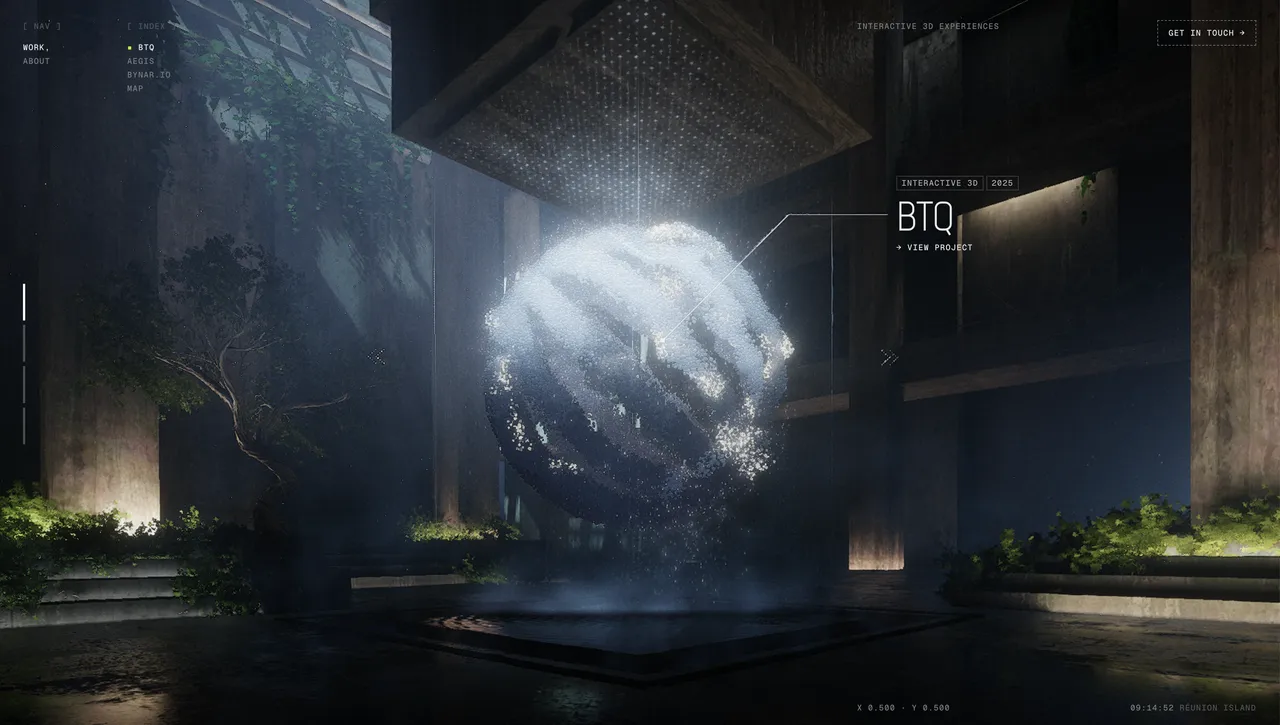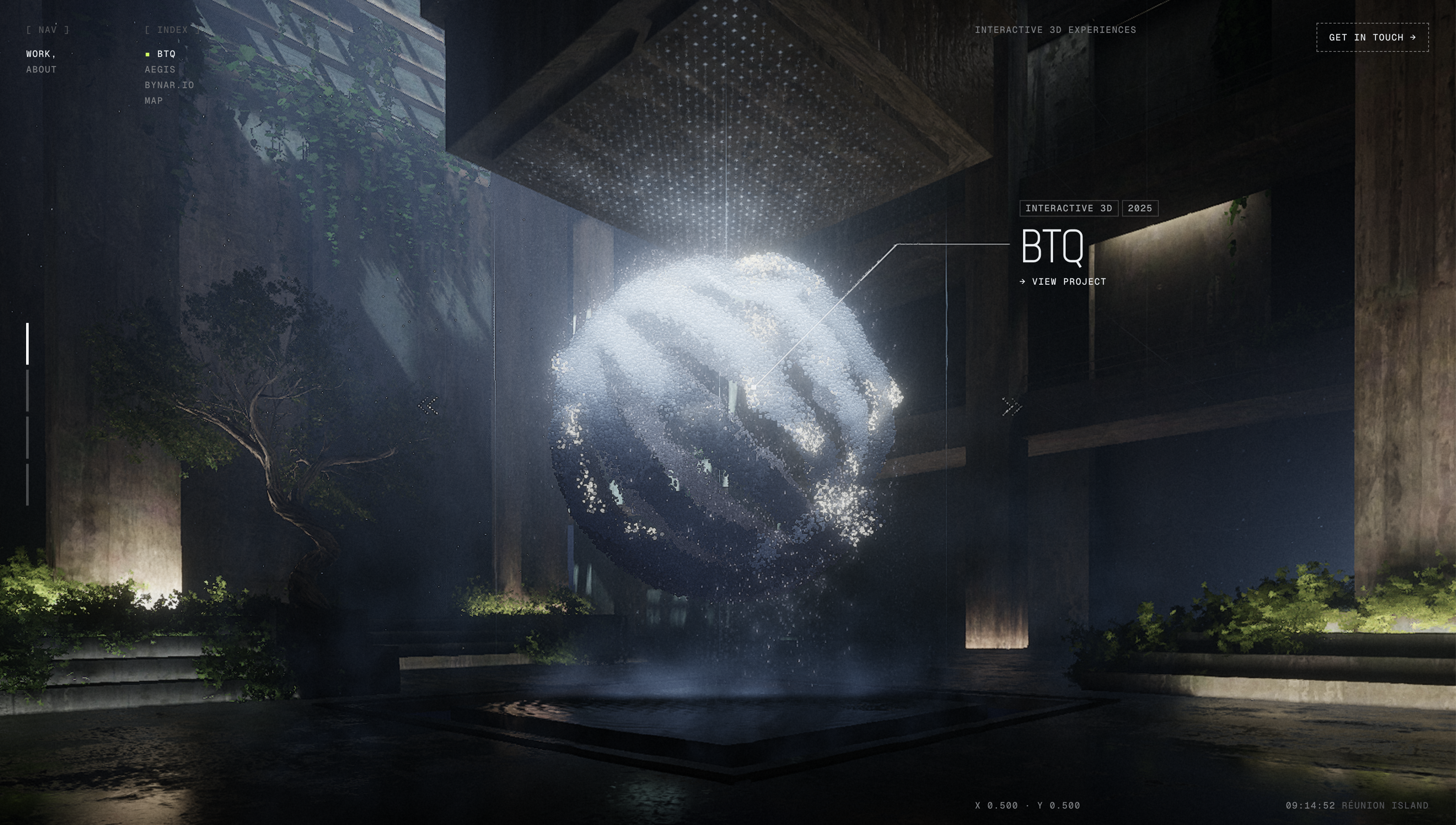
Bricelab opens as a sparse technical blueprint suspended in darkness. Holding the central control starts a deliberate construction sequence, replacing the wireframe with an explorable concrete atrium filled with vegetation, reflective surfaces, suspended mist, shafts of light, and a particle-driven curtain of water. The transformation is more than an entrance animation.
The production scene runs through Three.js r186’s WebGPU renderer, with a WebGL2 fallback when WebGPU is unavailable. Its art direction combines a Blender-authored GLB atrium with baked light and directional maps, separate vegetation models, TSL materials, screen-space reflections, post-processing, and GPU-driven particle effects. Custom systems handle the water curtain, its collisions and splashes, atmospheric mist, dust, animated light shafts, and the transition between architectural points, linework, and finished surfaces. It is an unusually cohesive demonstration of how modeling, baked assets, procedural effects, and interaction design can become one continuous browser experience.